Victoria’s Take-Home Naloxone Program allows more people who may experience or witness an opioid overdose to access free naloxone from an expanded range of organisations.
Contact
Kate Davenport Harm Reduction Coordinator
Phone (03) 5338 9164
Organisations approved to supply naloxone under the program
Naloxone can be accessed from Ballarat Community Health NSPs or via outreach by calling or texting the Harm Reduction Coordinator on 0448 871 391
Naloxone is a safe, non-addictive medication used to temporarily reverse the effects of an opioid overdose. Naloxone works by blocking opioids, such as heroin or oxycodone, from attaching to the opioid receptors in the brain, allowing a person to breathe again.
Naloxone will only work if a person has opioids in their system. It is available on prescription or as an over-the-counter medication.
In Australia naloxone is available in 3 easy to use formulations, Nyxoid nasal spray, Prenoxad pre-filled syringe and Ampoules (which require drawing up into a syringe).
What is Naloxone for?
Naloxone is available for anyone at risk of, or who may witness an opioid overdose.
People who are prescribed high doses of opioid medications such as oxycodone, morphine, fentanyl
People who use illicit opioids such as heroin
People returning to use after a period of abstinence
People using opioids in combination with other drugs or medicines such as alcohol, benzodiazepines or GHB.
People who use other illicit drugs such as cocaine – illicit drugs may be contaminated with opioids
Family and friends of people who use opioids, either prescribed or illicit
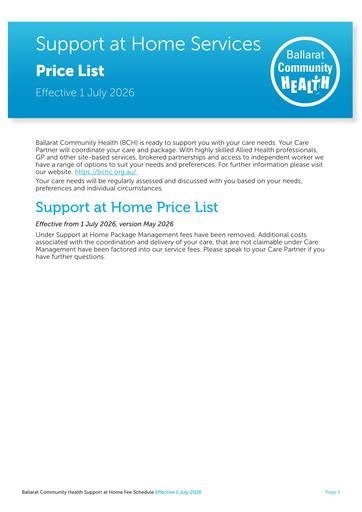
Ballarat Community Health provide Home Care Package Management (transitioned to Support at Home on 1 November 2025). As a recognised local, not-for-profit provider, we prioritise your wellbeing with a community-first approach. You’ll be supported by our experienced staff who specialise in home-care package management.
Helping you stay independent for longer
We’re committed to delivering accessible, affordable, and quality care tailored to your specific needs. We ensure seamless continuity of care from BCH healthcare settings, providing consistent and coordinated support throughout your care journey.
Our personalised care management approach, led by dedicated case managers, addresses your individual needs and preferences.
We maintain regular communication and commit to frequent face-to-face meetings with clients and their families, offering frequent check-ins and updates. Our commitment to a supportive and trustworthy service is underscored by transparent practices, reliable service, and empathetic interactions.
Services
Around your home
House cleaning
Laundry/ironing
Spring cleaning
Decluttering
Gardening/yard cleaning
Home maintenance
Your safety at home
Safety pendants
Home modifications (ramps, rails, visual alarms)
Mobility aids
In your kitchen
Groceries
Meal preparation
Nutritional information
Dietary supplements
Home delivered meals
Personal care
Bathing and showering
Grooming and personal care
Personal products
Continence care and aids
Dressing and undressing
Clinical care /allied health
Physiotherapy
Podiatry
Exercise physiology
Occupational therapy
Nursing
Dietetics
Getting active
Exercise assistance at home
Walking companion
Transport and accompaniment to classes
Stretching and mobility assistance
Transport
Transport and/or accompaniment to
Appointments
Shopping trips
Social outings
Community or religious events
Social support
Company at home doing things you enjoy – baking, games, crafts etc.
We’re committed to delivering accessible, affordable, and quality care tailored to your specific needs. We ensure seamless continuity of care from BCH healthcare settings, providing consistent and coordinated support throughout your care journey.
Our personalised care management approach, led by dedicated case managers, addresses your individual needs and preferences.
What is the Support at Home program and what does it replace?
Support at Home is a new in-home aged care program that commenced on 1 November 2025. It replaces the Home Care Packages (HCP) Program and Short-Term Restorative Care (STRC) Programme. This program is designed to provide coordinated care and services to meet the assessed ageing-related care needs of eligible older people. The program officially replaces the previous Home Care Packages (HCP) Program and the Short-Term Restorative Care (STRC) Programme.
How do I access funding and determine my eligibility for Support at Home?
Access to funded aged care services begins by registering with My Aged Care. You will participate in an aged care assessment, which determines your eligibility for ongoing and/or short-term services. Following the assessment, you will receive a Notice of Decision and a Support Plan outlining your approved funding classification, recommended services, and identified needs and goals.
What types of services are included in the Support at Home program?
Funded aged care services under Support at Home are grouped into three main categories:
1. Clinical Supports: Includes specialized services like nursing care, occupational therapy, and physiotherapy.
2. Independence: Covers support for daily living activities such as personal care, social support, community engagement, respite care, and transport.
3. Everyday Living: Provides support for domestic assistance, home maintenance and repairs, and meals.
The specific services you are eligible to receive are determined by your assessed needs and outlined in your Notice of Decision and support plan.
How is my Support at Home budget managed and what happens to unspent funds?
Your funding is allocated based on your approved classification and is generally divided into a quarterly budget. Ten percent (10%) of your quarterly budget for ongoing services is automatically deducted and pooled into a care management account held by Services Australia, which the provider uses flexibly for care management activities across all participants in that service branch.
If your quarterly budget is not fully utilized, the unspent amount can carry over to the next quarter, up to a maximum limit of $1,000 or 10% of the quarterly budget, whichever amount is higher.
Do I have to contribute financially to my Support at Home services?
You may be required to pay participant contributions, which are based on an assessment of your income and assets completed by Services Australia.
Clinical Supports (e.g., nursing, allied health) have a contribution rate of 0% and are fully funded by the government.
Independence and Everyday Living services may require a contribution based on your assessment.
If you face genuine financial hardship and cannot afford your contributions, your provider can assist you in applying for the Fee Reduction Supplement through Services Australia.
What does Care Management involve and how frequently will it occur?
Care management is a mandatory ongoing core service delivered by your Support at Home provider through a staff member known as a care partner. The activities involve initial and ongoing coordination, care planning, service management, budget review, and monitoring.
Your provider must deliver at least one direct care management activity (minimum 15 minutes) to you every month. Care partners should review and update your care plan at least once every 12 months, or sooner if your needs or circumstances change.
What is the Assistive Technology and Home Modifications (AT-HM) scheme?
The AT-HM scheme is one of the three short-term classifications, providing separate funding tiers for older people who need equipment, products, and home modifications to increase independence and safety at home. This funding is separate from your budget for ongoing Support at Home services. Examples of items include mobility equipment (like wheelchairs and walking frames) and modifications (like grab rails and ramps).
What is end-of-life pathway?
The End-of-Life Pathway is a short-term classification designed to support participants who have been diagnosed with 3 months or less to live and meet the eligibility criteria. This pathway provides a one-off budget of $25,000 over a 12-week period (with potential access to funds up to 16 weeks), enabling access to approved services from the Support at Home service list to complement palliative care services.
How quickly must I start services once my funding is allocated?
Once your funding (including interim funding) is allocated, you have 56 calendar days to find a provider and enter into a service agreement. You can contact My Aged Care to request an extension of 28 days, giving you a total of 84 calendar days. If you do not enter into a service agreement within this timeframe, your funding for that classification will be withdrawn.
Can I change providers or stop my services temporarily?
Yes, you can change Support at Home providers at any time. You should inform your outgoing provider of your decision and agree on an exit date to ensure continuity of care and appropriate transfer of records.
There are no formal leave arrangements under Support at Home for temporarily stopping services. However, if services are stopped temporarily, your quarterly budget continues to be credited. Be aware that your funding will be reduced to zero and reallocated if a total of four consecutive quarters (one year) pass since the end of the quarter from when the last service was delivered.
How long can I stop receiving services before my funding is withdrawn?
There are no formal leave arrangements under Support at Home. Your funding remains allocated while services are stopped, and your quarterly budget continues to be credited (though carryover limits apply). However, your funding will be reduced to zero and reallocated if a total of four consecutive quarters (one year) pass since the end of the quarter in which the last service was delivered.
How does the planning process differ if I access the Restorative Care Pathway?
The Restorative Care Pathway provides intensive, short-term care (up to 16 weeks) focused on regaining function. For this pathway, a detailed Goal Plan is mandatory and replaces the standard Care Plan required for ongoing services. The Goal Plan must identify specific, measurable goals achievable within the 16-week episode, supported by clinical services, and includes frequent progress reviews. An Exit Plan must also be completed by the restorative care partner to determine necessary next steps or ongoing support once the episode concludes.
What documents will I receive outlining my services and expenditure?
You will receive several documents detailing your approved care and funding:
I. Notice of Decision: Received after assessment, outlining your approved classification and services.
II. Service Agreement: Entered into with the provider before services commence, detailing the price, scope, and terms of service delivery.
III. Individualised Budget: Developed in partnership with the provider, detailing government funding, supplements, costs of each service, and contributions.
IV. Monthly Statement: Must be issued no later than the last day of the following calendar month (e.g., the January statement must be issued by February 28th). This statement details the available funding, services delivered, contributions paid, and remaining budget.
MAP is a program to support people from multicultural backgrounds to access primary healthcare services at no cost. Ballarat Community Health in partnership with BRMC (Ballarat Regional Multicultural Council) offer Multicultural Health Clinics, held at Ballarat Welcome Centre, 25/39 Barkly St, Bakery Hill.
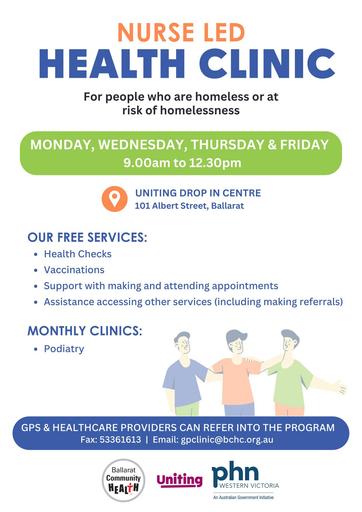
HAP is a program providing support to those experiencing homelessness or are at risk of homelessness. The program provides access to a nurse at no cost to support people with their health and wellbeing needs.
Ballarat Community Health in partnership with Uniting Vic.Tas offer a Health Clinic, held on Monday, Wednesday, Thursday and Friday, 9am to 12.30pm at Uniting Drop in Centre, 101 Albert Street, Ballarat. This is a free service.
Nurse Led Health Clinic
Health checks
Vaccinations
Support with making and attending appointments
Assistance accessing other services (including making referrals)
Podiatry (monthly additional clinic)
GPs and Healthcare Providers can refer into the program. Fax 5336 1613 or email [email protected]
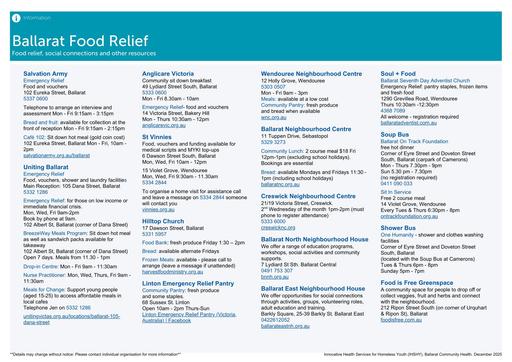
Ballarat offers a wide range of food relief services to support individuals and families experiencing financial hardship and food insecurity.
From emergency food parcels and hot meals to low-cost groceries and community lunches, local organisations such as the Salvation Army, Uniting Ballarat, Anglicare, St Vincent de Paul, and Ballarat Neighbourhood Centre provide essential assistance across the region.
The Ballarat Community Food Centre, operated by Foodbank Victoria, further strengthens this support network by distributing fresh and healthy food to local agencies, offering food education programs, and running a community supermarket for students and residents in need.
Together, these services ensure that no one in Ballarat goes hungry and that everyone has access to nutritious food and compassionate care.
Ballarat food relief, social connections and other resources. Compiled by the Innovative Health Services for Homeless Youth (IHSHY), Ballarat Community Health December 2025.
Details may change without notice, contact organisation to confirm they are open and have food. Updated 26/11/25.
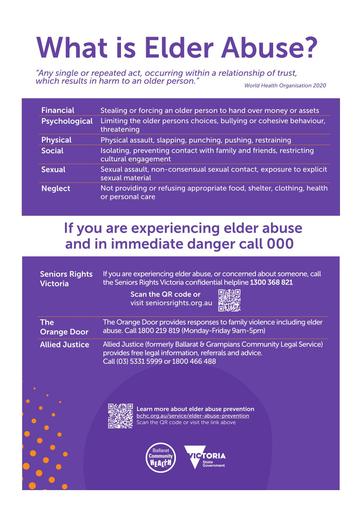
Elder abuse is any mistreatment of an older person by another person with whom they have a relationship of trust. Often that person is a family member or carer, but could also be a friend or neighbour who they depend upon.
The abuse can be financial, psychological, emotional, physical or sexual, or could involve social isolation or neglect of the older person.
Contact
If you’re interested in booking a session or presentation on Elder Abuse for your organisation, club or group you can make an email enquiry.
In May 2017 the Victorian Government launched the ‘Free from violence strategy’ to prevent family violence and all forms of violence against women. Although the strategy is primarily focused on violence against women, it acknowledges that elder abuse affects both older men and women, can be perpetrated by both men and women with whom the older person has formed a relationship of trust, such as a son, daughter, close friend or partner. It is through this strategy that Ballarat Community Health received funding from the Department of Health and Human Services (DHHS) for a project to coordinate a regional Elder Abuse Prevention Network.
The Central Highlands Elder Abuse Prevention Network (CHEAPN) aims to reduce the incidence of elder abuse in the Central Highlands region. It achieves this by further expanding the CHEAPN and supporting organisations and community groups in primary prevention activities to stop elder abuse before it starts, in line with the Victorian Government’s ‘Free from violence’ strategy. The network targets six local government areas in the Central Highlands and Grampians region (Ararat, Ballarat Golden Plains, Hepburn, Moorabool and Pyrenees).
The project is supported by the peak body Seniors Rights Victoria, which provides information, support, advice and education to help prevent elder abuse and safeguard the rights, dignity and independence of older people. Seniors Rights Victoria also provides leadership on policy and law reform and works with other organisations to raise awareness of elder abuse.
The network includes over 30 organisations and community groups that have committed to taking action against elder abuse.
Why this happens, why this is important
Prevention of elder abuse is important given the rising number of older people in Australia, lack of reporting, difficulty in resolving problems once they happen and damage to family relationships that can occur.
Tackling the drivers of elder abuse requires addressing ageism and other forms of potential disadvantage, such as cultural and linguistic difference, disability, racism and sexual orientation, as well as gender equality.
What to do if you are concerned that someone is experiencing elder abuse
Talk to the person you are concerned about. Invite them to talk in a place where they are alone and safe.
Listen to the person. Offer them your time and your support and respect their right to make their own decisions.
Remind them they are not to blame and that everyone has the right to live in safety and be treated with dignity and respect.
Let them know that help is available and offer to assist them in getting the necessary support if and when they are ready to do so.
Encourage them to call Seniors Rights Victoria on 1300 368 821 for advice and assistance. If they are unable to call but you know they want to speak to someone, you can call on their behalf and Seniors Rights Victoria will arrange a way to speak to them by phone, at their offices or, if necessary, at the older person’s home.
Continue to offer support and encouragement even if the person is not ready to accept help at this point in time.
If there is an immediate risk of physical harm or damage to the older person’s property call the police on 000.
The police can help in a number of ways, including removing the abuser and/or applying for an Intervention Order on the older person’s behalf. This is a court document that will help protect the older person against further violence.
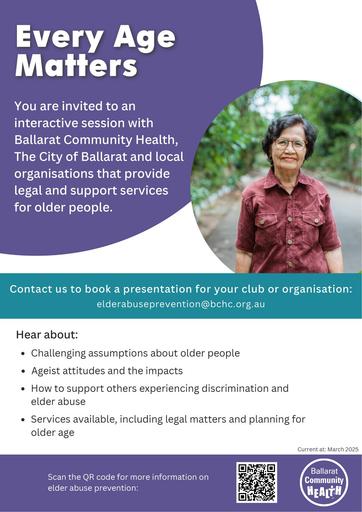
Interactive sessions for your club or organisation
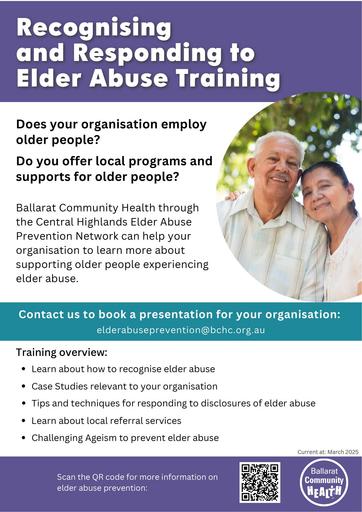
Recognising and Responding Training
A training presentation for organisations that employ older people or offer local programs and supports for older people.
Elder Abuse Services brochure. If you believe you or someone you know are experiencing elder abuse, your GP, or any of this resource can help and provide advice.
These guidelines will provide support for handling disclosures that may occur while undertakingactivities that contribute to the work of the Central Highlands Elder Abuse Prevention Network(CHEAPN). It focuses on disclosures that relate to older people’s health and wellbeing, in particularexperiences of violence against older people.
Speech pathologists at Ballarat Community Health work closely with parents and carers to help support a child’s growth and development in all areas of communication.
Ballarat Community Health accept referrals for children between the ages of 2 – 8 years. We are able to assess and treat the following areas
Speech – Speech sounds and how a child can be understood by others in conversation.
Language – The understanding of concepts, following directions, listening, telling stories, and being able to communicate their needs and wants.
Social skills – The use of communication skills in social situations.
Stuttering – When a child is repeating sounds, words, or phrases during conversation.
Ballarat community Health can assist children and families of all abilities in a supportive and neurodiversity-affirming environment.
Speech pathology services are offered at the Ballarat Community Health Lucas site.
We encourage all children to have a hearing test. For further information on how to arrange a hearing test please discuss with your GP.
Ready to Get Started?
Allied Health Services at Ballarat Community Health are often in high demand. Please contact our customer service team on 03 – 5338 4500 or complete the referral form below to confirm availability of the service you require.
GP’s or health professionals wanting to refer a client please complete the referral form below or fax your referral to 03 -5338 1613. We prefer referrals via ReferralNet- ReferralNet ID: urn:refnet:ballaratappt
Foot and leg pain should not be a part of your daily life and can unnecessarily impair your mobility and health. A podiatrist is a health professional who deals with the prevention, diagnosis, treatment and rehabilitation of medical and surgical conditions of the feet and lower limbs.
Caring for the health of your feet begins at any age—the earlier the better! Early detection and management in babies and children can help reduce foot problems in later life. Ballarat Community Health podiatrists are located at the BCH Lucas, Wendouree, Sebastopol and Smythesdale sites.
They provide professional and affordable footcare for all ages, with service prioritised for individuals on a healthcare card or pension. They can help with
sore or aching feet
gait analysis and orthoses (support wear for feet and lower limbs, like orthotics, braces, splints, etc.)
diabetes care and assessments
general treatment
ingrown toenails and nail surgery
footwear advice
Ready to Get Started?
Allied Health Services at Ballarat Community Health are often in high demand. Please contact our customer service team on 03 – 5338 4500 or complete the referral form below to confirm availability of the service you require.
GP’s or health professionals wanting to refer a client please complete the referral form below or fax your referral to 03 -5338 1613. We prefer referrals via ReferralNet- ReferralNet ID: urn:refnet:ballaratappt
Physiotherapy is for more than just back pain. Physios can help with chronic disease, injury management and prevention, general pain, headaches—and much, much more. It has been found that physiotherapy is more effective in treating various conditions and injuries than either surgery or medication, so it’s important to see if a physio can help you with your condition.
BCH physiotherapists (physios) can help with sore body parts and limbs, dizziness and headaches, chronic conditions, post-surgery rehabilitation, and much more. Physiotherapy services are available to all people, including frail older people and people with disabilities.
Our physiotherapists will work with you to restore your function and independence. They aim to reduce pain and improve function and quality of life, utilising treatment techniques such as manual therapy, exercise and education, as well as guiding you toward self-management. Our physiotherapists treat conditions such as
back and neck pain
chronic conditions such as arthritis
post-surgery (eg, knee and hip replacements, shoulder surgery)
general joint and muscle pain/injury or weakness
reduced mobility
dizziness caused by conditions such as BPPV (benign paroxysmal positional vertigo) as well as other conditions contributing to dizziness.
We also provide children’s physiotherapy services, which can help your child to improve
motor development
strength
range of motion
endurance
gait difficulties
balance
coordination
delayed motor development.
Ballarat Community Health has qualified physiotherapists practicing at Lucas, Sebastopol and Wendouree.
Along with general outpatient treatment, there are several new and continuing programs available, including pole walking and the stroke group.
A GP referral may be required to access this service in some instances.
Ready to Get Started?
Allied Health Services at Ballarat Community Health are often in high demand. Please contact our customer service team on 03 – 5338 4500 or complete the referral form below to confirm availability of the service you require.
GP’s or health professionals wanting to refer a client please complete the referral form below or fax your referral to 03 -5338 1613. We prefer referrals via ReferralNet- ReferralNet ID: urn:refnet:ballaratappt
Looking to improve the way you eat? Manage or prevent diabetes? Just feel healthier? Our BCH dietitians are here to support. Healthy eating and nutrition have long been considered one of the cornerstones of human wellbeing, but it’s not always simple in practise.
The dietitians at Ballarat Community Health work within a multidisciplinary team to help you to understand the relationship between food and health.
Our team can offer evidence based, non-judgemental support with food and eating, working with you to help meet your needs and support your goals.
All dietitians employed at BCH are accredited practising dietitians (APDs) and offer a range of support in many different areas, including
general nutrition and healthy eating
diabetes and prevention of diabetes
heart health, cholesterol and high blood pressure
assistance to manage gout through diet
fussy or selective eating
improving your relationship with food
body image concerns
nutrition for pregnancy and breastfeeding
nutrition for healthy ageing
stomach and gut issues
food intolerance and allergy
vegetarian and vegan eating
loss of strength or energy
vitamin and mineral deficiencies
confusion about popular diets.
Carmen Goldsborough
Carmen is an Accredited Practising Dietitian and Credentialed Diabetes Educator working primarily within her area of expertise, Diabetes. Carmen is keen to support people living with diabetes to achieve their health goals.
As a DAFNE (Dose Adjustment for Normal Eating) facilitator Carmen can support people living with Type 1 Diabetes with carbohydrate counting, managing exercise and insulin dose adjustment.
You can find Carmen at our Wendouree (Howitt St) and Sebastopol sites.
Zoe McCuskey
Zoe is an Accredited Practising Dietitian. She has a passion for making nutrition information easy to digest and facilitating positive relationships with food.
In addition to practicing with a non-diet approach, Zoe can help you with a range of food and nutrition related concerns such as; diabetes, heart and gastrointestinal health, malnutrition and disordered eating.
You can find Zoe at our Lucas, Sebastopol & headspace Ballarat sites.
Felicity Robinson
Felicity is an Accredited Practicing Dietitian. In addition to a special interest in gastrointestinal health, she sees people with diabetes, high cholesterol, malnutrition and for general healthy eating.
Felicity is a certified LIFE! facilitator and runs regular groups for diabetes, stroke and heart disease prevention. You can find Felicity at our Wendouree (Howitt St) and Sebastopol sites.
Elaine Donovan
Elaine is an Accredited Practising Dietitian. Elaine enjoys working with clients to achieve their nutrition related health goals particularly in the areas of digestive health, heart health, diabetes and malnutrition. Elaine is trained in the Low FODMAP Diet Approach.
You can find Elaine at our Lucas and Sebastopol sites
Jane Martin
Jane is an Accredited Practicing Dietitian. She can help you with a range of nutrition concerns such as heart health, diabetes, malnutrition, and general healthy eating. Jane also has a strong interest in gut health, helping people form a positive relationship with food, and empowering people to make better and informed choices with their food and nutrition.
You can find Jane at our Lucas and Sebastopol sites.
Ready to Get Started?
Allied Health Services at Ballarat Community Health are often in high demand. Please contact our customer service team on 03 – 5338 4500 or complete the referral form below to confirm availability of the service you require.
GP’s or health professionals wanting to refer a client please complete the referral form below or fax your referral to 03 -5338 1613. We prefer referrals via ReferralNet- ReferralNet ID: urn:refnet:ballaratappt